
Key Takeaways
- The best Magento product search extensions in 2026 are Mirasvit (most technically advanced, $249), Amasty ($269–$499 tiered), MageArmy ($99 flat for small/medium stores), and Adobe Live Search (free with Adobe Commerce licenses).
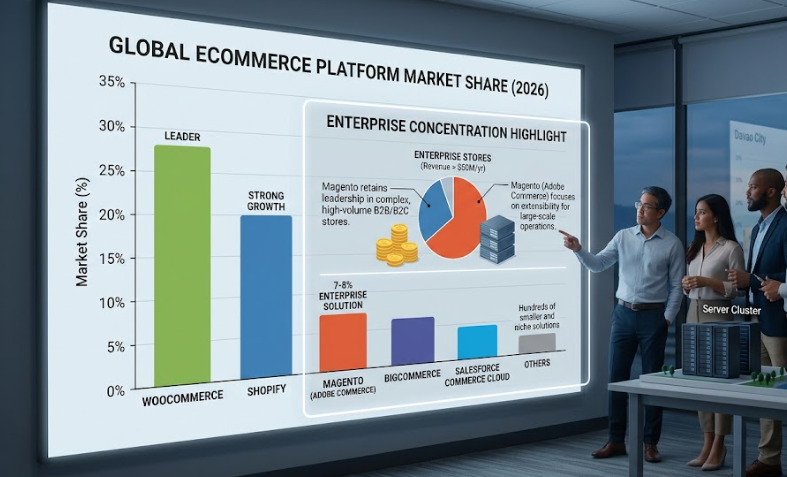
- As of Q1 2026, Magento powers 111,495 active stores and holds 7–8% global ecommerce platform market share — third behind WooCommerce and Shopify by store count but dominant in enterprise, with 20% of top US retailers using Magento.
- Nike does not publicly confirm its ecommerce platform, but several Nike regional and subsidiary sites have historically run on Magento infrastructure alongside enterprise custom solutions.
- Adobe acquired Magento on June 19, 2018 for $1.68 billion in cash, driven by its strategic vision to enhance its Experience Cloud suite by adding ecommerce capability to complement its marketing and customer experience tools.
- Getting best-seller products in Magento 2 requires either a custom collection filtered by order quantity, a bestseller report in the admin, or a third-party extension that surfaces top-selling SKUs dynamically.
Does Anyone Still Use Magento?
Yes — and the usage profile in 2026 tells a more nuanced story than the store count decline suggests. Magento powers 111,495 active stores in Q1 2026, down 10% year-over-year, while Shopify crossed 6 million stores. However, Magento holds 7–8% of the global ecommerce platform market share and processes an estimated $173 billion in annual GMV.
The key insight is where Magento’s strength lies: store count is declining, but revenue per store is growing. 20% of the top 1,000 US retailers use Magento. Small merchants migrate to Shopify for lower complexity and cost, but Magento remains the top open-source platform for enterprise ecommerce and B2B.
Magento is still the number one B2B ecommerce platform, with B2B stores on Magento seeing an average order value 2.5 times higher compared to their B2C counterparts. The platform’s strength isn’t in volume of small stores but in the revenue concentration of the large ones it powers — a different but equally meaningful market position.
The Magento Open Source platform has surpassed 2.5 million downloads, and over 3,890 Magento extensions are offered by the Magento community. The developer ecosystem remains active, extension quality continues improving, and Magento 2.4.8 (released April 2025) introduced PHP 8.4 support and 497 core bug fixes, demonstrating continued active development.
Why Did Adobe Buy Magento?
Adobe’s decision to acquire Magento was driven by its strategic vision to enhance its Experience Cloud suite — by integrating Magento Commerce, Adobe aimed to furnish an all-in-one platform for merchants to establish, operate, and refine their online presence across various channels.
The strategic logic was straightforward: Adobe was the undisputed leader in digital content creation (Creative Cloud) and digital marketing/experience management (Experience Cloud) prior to the deal — but the Experience Cloud had a critical gap. It had no native ecommerce capability. Salesforce had filled the same gap by acquiring Demandware for $2.8 billion in 2016. SAP had acquired Hybris. Oracle had acquired ATG. Adobe was the last major marketing cloud without a commerce platform.
Adobe acquired Magento to offer a complete digital experience platform combining Adobe’s creative tools with Magento’s ecommerce capabilities — together creating a unified platform for B2B and B2C businesses that supports everything from content to order management, positioning Adobe to compete with Salesforce Commerce Cloud and SAP Commerce at the enterprise level.
The acquisition also gave Adobe immediate access to Magento’s vast global partner network, its open-source developer community, and its dominant position in B2B commerce — three assets that couldn’t be quickly built from scratch regardless of Adobe’s development budget.
Does Nike Use Magento?
Nike does not publicly confirm the ecommerce platform powering its primary storefront (nike.com), which runs on proprietary enterprise infrastructure developed internally. However, Nike has historically used Magento for specific regional websites and subsidiary brands within its portfolio — a pattern common among major enterprise retailers who run a custom-built primary storefront alongside platform-based storefronts for secondary channels.
Several prominent enterprise brands across apparel, sports equipment, and consumer goods have publicly confirmed Magento/Adobe Commerce deployments — including Harborfreight.com, which is the leading Magento site in the US with 40 million visitors per month. The broader enterprise roster includes food and beverage brands, automotive retailers, and fashion companies whose complex B2B requirements align with Magento’s specific strengths.
The Best Magento Extensions for Product Search in 2026
Adobe Commerce Live Search — Best for Adobe Commerce Merchants
Adobe Live Search replaces Magento’s default Elasticsearch-based search with a Sensei-powered engine providing synonym management, merchandising rules, boosting and burying, faceted navigation, and query autocomplete, with an AI layer that learns from search behavior to improve result relevance. Included free with Adobe Commerce licenses; not available for Magento Open Source. For merchants already paying Adobe Commerce licensing costs, this is the obvious first evaluation — it’s a significant improvement over default search included in the license fee.
Mirasvit Elasticsearch Extension — Best for Magento Open Source at Scale
The Mirasvit extension powers search for thousands of Magento stores, from catalogs of a hundred products to millions of SKUs, returning relevant results within milliseconds across products, categories, CMS pages, and 15+ other content types. At $249 for the full relevance and autocomplete toolkit in a single edition, self-hosted on your own Elasticsearch or OpenSearch, Mirasvit provides the complete search feature set without ongoing SaaS subscription costs.
Features include search weights, score-boost rules, singular/plural handling, stemming, wildcards, and spell correction — all running on your own infrastructure with no per-query fee. The 2026 release added llms.txt support and Hyvä theme compatibility, making it the most future-proofed self-hosted option currently available.
Best for: Mid-to-large catalogs on Magento Open Source or Adobe Commerce on-premises where search infrastructure control and no per-query costs are priorities.
Amasty Advanced Search — Best Enterprise Depth
Amasty Elastic Search offers fast and relevant search results for Magento sites, leveraging Elasticsearch to provide blazing-fast, precise search results alongside synonym support, spell correction, and search analytics. The three-tier pricing ($269 Advanced, $329 Elastic, $499 Premium for AI content generation) means Amasty scales from growing stores to enterprise implementations without requiring a platform change.
Best for: Enterprise stores with complex relevance requirements, multilingual catalogs, or teams that need detailed search analytics alongside the core search functionality.
MageArmy Elasticsearch Autocomplete — Best Small/Medium Store Value
For small and medium-sized Magento merchants, MageArmy Elasticsearch Autocomplete & Product Suggestion is the top choice, offering weight-based relevance, SKU search, and synonym support at a competitive flat price of $99 for both Open Source and Adobe Commerce.
Best for: Stores that want meaningful search improvement over default Magento without enterprise-level investment, particularly those running the Hyvä theme where compatibility matters.
Algolia for Magento — Best for High-Traffic SaaS
Algolia indexes product data in an external hosted service and answers every query from their infrastructure — very fast, with no load on Magento, but because results are drawn outside Magento, they are harder to fit to your storefront’s look and logic. Monthly SaaS pricing makes it less cost-effective at high volume than one-time licensed alternatives but eliminates search infrastructure management entirely.
Best for: High-traffic stores where maximum search speed justifies ongoing SaaS subscription costs and off-server architecture is acceptable.
How to Set a Search Term for SEO in Magento
Setting search terms in Magento connects specific customer queries to specific destination pages — either directing customers to a curated result set or sending them directly to a landing page via redirect:
- Navigate to Marketing → SEO & Search → Search Terms in the Magento admin panel.
- Click “Add New Search Term” or select an existing term from the list to edit it.
- Enter the Search Query — the keyword or phrase exactly as customers would type it.
- Optionally set a Redirect URL — sending customers who search for “sale”, “new arrivals”, or a specific brand directly to a targeted landing page rather than a standard search results page.
- Select the Store View — applying the term to one specific store view or all store views.
- Save and test — confirm the behavior in the storefront before considering the term configured.
The Search Terms report also surfaces the most-searched terms in your store’s history — valuable data for merchandising decisions, synonym configuration in search extensions, and identifying queries that are generating searches but failing to convert to purchases.
How to Get Best Seller Products in Magento 2
Getting best-seller products programmatically in Magento 2 requires querying sales order data and joining it to product data. Three approaches depending on context:
Via the Magento Admin Report:
Navigate to Reports → Products → Bestsellers. This built-in report shows products ranked by quantity sold within a configurable date range — the simplest method for manual review without code.
Programmatically Using a Collection (Recommended for Display):
php
use Magento\Sales\Model\ResourceModel\Report\Bestsellers\CollectionFactory;
class BestsellerProducts
{
private CollectionFactory $bestsellersFactory;
public function __construct(CollectionFactory $bestsellersFactory)
{
$this->bestsellersFactory = $bestsellersFactory;
}
public function getBestsellers(int $limit = 5): array
{
$collection = $this->bestsellersFactory->create()
->setPeriod(‘month’)
->setDateRange(null, null)
->addStoreFilter(1)
->setPageSize($limit)
->load();
return $collection->getItems();
}
}
Via Third-Party Extension:
Several Magento extensions provide configurable bestseller widgets deployable in CMS pages, product pages, and homepage blocks without custom development — Mageplaza, Amasty, and Mirasvit all publish bestseller/related product extensions that surface top-selling SKUs dynamically based on configurable date ranges and sales thresholds.
How to Choose the Right Magento Product Search Extension
The right answer for the best extension depends less on which has the longest feature list and more on where your store is right now:
New or small catalog (under 500 SKUs): MageArmy at $99 provides meaningful search improvement over Magento default at an appropriate investment level. Mageplaza’s free community tier is worth evaluating before any paid purchase.
Growing catalog (500–10,000 SKUs): Mirasvit at $249 covers the full self-hosted feature set at a reasonable one-time cost. MageDelight is worth comparing at $199/year.
Enterprise catalog (10,000+ SKUs, multiple store views, international): Mirasvit or Amasty depending on which feature set aligns better with specific requirements. Adobe Commerce merchants should evaluate Live Search before any third-party purchase.
High-traffic, SaaS-preferred: Algolia or Klevu/Athos Commerce for managed search infrastructure at subscription pricing.
Common Mistakes When Evaluating Magento Search Extensions
- Evaluating feature lists without assessing performance at your specific catalog size — an extension that performs excellently at 1,000 SKUs may behave differently at 100,000 SKUs; request references or case studies from comparable catalog sizes.
- Choosing SaaS search without calculating total cost of ownership at current traffic — per-query SaaS pricing can exceed one-time self-hosted licensing costs quickly at high search volumes.
- Assuming Adobe Commerce Live Search eliminates the need to evaluate third-party options — Live Search is excellent for most use cases but lacks some merchandising depth that Mirasvit and Amasty provide for complex catalog configurations.
- Installing a search extension without first auditing zero-result queries — the synonym dictionary and fuzzy search configuration that immediately improves search quality can only be built from real zero-result data.
- Ignoring Hyvä compatibility if running or planning to run the Hyvä frontend — Hyvä-compatible extensions are a meaningfully smaller set than Luma-compatible ones; confirming compatibility before purchase prevents a costly mid-project discovery.
Wrapping Up
The best Magento product search extension in 2026 is determined by three factors: your Magento edition (Adobe Commerce or Open Source), your catalog size, and your infrastructure preference (self-hosted versus SaaS). Adobe Commerce merchants should evaluate Live Search first; Open Source merchants have strong options from $99 (MageArmy) to enterprise-scale (Mirasvit, Amasty). Magento’s place in the market is narrower than it once was — but the stores it powers are larger, and the ecosystem continues producing serious extensions for serious ecommerce needs.
Frequently Asked Questions
How do you set a search term for SEO in Magento?
Navigate to Marketing → SEO & Search → Search Terms in the Magento admin, create a new search term with the query text, and optionally configure a redirect URL to send shoppers directly to a targeted landing page rather than a search results page.
Does anyone still use Magento?
Yes — Magento powers 111,495 active stores in Q1 2026 and processes approximately $173 billion in annual GMV. Store count is declining as small merchants move to Shopify, but Magento remains the dominant enterprise platform with 20% of top US retailers and the leading B2B ecommerce solution globally.
How do you get best seller products in Magento 2?
Use the built-in admin report at Reports → Products → Bestsellers for manual review, or query the bestsellers collection programmatically using Magento\Sales\Model\ResourceModel\Report\Bestsellers\CollectionFactory for dynamic frontend display. Third-party bestseller extensions from Mageplaza and Amasty provide configurable widgets without custom code.
Does Nike use Magento?
Nike’s primary nike.com storefront runs on proprietary internal infrastructure rather than any single commercial platform. Nike has historically used Magento for specific regional and subsidiary sites, a pattern common among major enterprise retailers who combine custom-built primary storefronts with platform-based secondary channels.
Why did Adobe buy Magento?
Adobe acquired Magento in June 2018 for $1.68 billion to fill a critical gap in its Experience Cloud — adding native ecommerce capability to complement its existing marketing, content, and analytics tools, positioning Adobe to compete with Salesforce Commerce Cloud and SAP Commerce at the enterprise level.